Amazon PPC Agency vs In-House Management: How to Choose
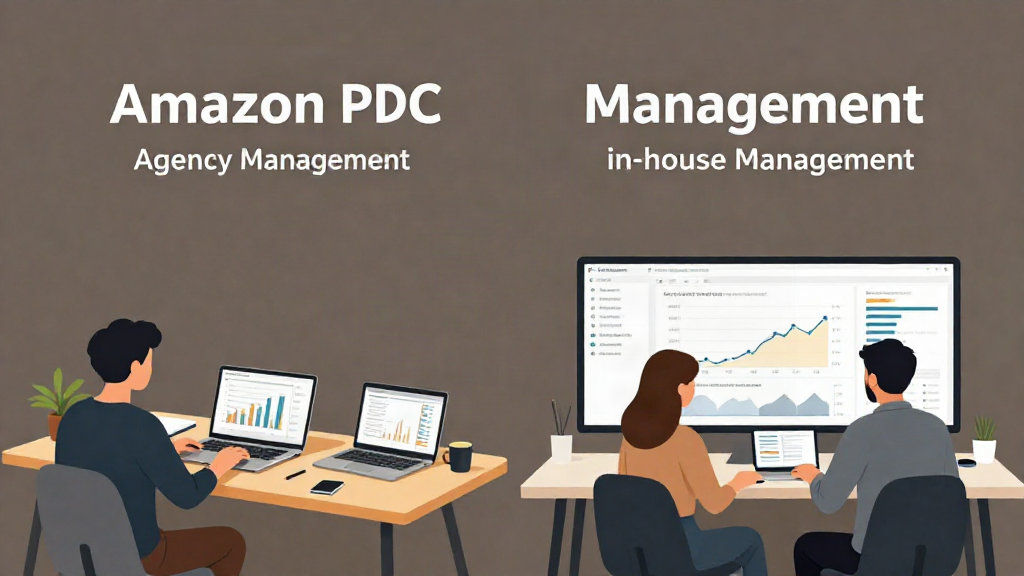
Most Amazon brands reach the same crossroads at some point: advertising is driving a large share of revenue, the numbers are getting harder to read, and someone has to own the account. The decision that follows is rarely about whether PPC matters - it is about who runs it. Amazon PPC agency vs in-house management is one of the most consequential choices a growing brand makes, because it shapes your cost structure, your control over the account, and how quickly you can react when the market moves.
This comparison sets out what each model actually requires, where an agency adds leverage, and a practical framework for choosing based on your growth stage.
What in-house Amazon PPC management really involves
Managing Amazon advertising in-house is not a single job. It is a stack of specialist skills that have to be covered before a campaign even goes live.
- Strategy and structure. Building campaign architecture around search term intent, brand vs non-brand split, and product portfolio priorities.
- Bid and budget management. Daily pacing decisions across Sponsored Products, Sponsored Brands, and Sponsored Display, adjusting bids against target ACoS and ROAS thresholds.
- Search term analysis. Mining the search term report for waste to negate and winners to harvest, then feeding that intelligence back into listing keywords.
- Creative and listing alignment. Main image, A+ content, and copy that convert the traffic paid ads buy.
- Reporting and diagnosis. Turning raw datasets into a clear view of what is working and what is leaking budget.
Doing this well requires an analyst who understands the Amazon auction, a strategist who understands your category, and a copy or creative resource - or one very capable generalist. Beyond salaries, there is a real cost in ramp-up time, tooling, and the opportunity cost of decisions made without full information.
Where the in-house model wins
Control is the strongest argument. You own the account data, you can move on an insight the same hour, and institutional knowledge stays inside the business. For a single mature hero product with stable demand and a proven playbook, an in-house owner who already knows the niche can be efficient and deeply accountable.
Where an Amazon PPC agency adds leverage
An agency model sells specialisation and speed. The strongest agencies bring three things an in-house hire usually cannot replicate on day one.
Budget pacing and ACoS control. Bid and budget decisions are made daily, not weekly. That frequency is where wasted ad spend is recovered - wasted impressions, poor placements, and search terms that quietly drain budget are caught before they compound.
Bid strategy across a whole portfolio. An agency is constantly testing bidding approaches across many accounts, so it brings pattern recognition: what worked in an adjacent category, which campaign structures hold up as spend scales.
Systems and reporting. Good agencies ship a reporting layer that turns Amazon's native reports into decisions - revenue leaks, listing gaps, and untapped growth vectors made visible rather than guessed at.
The trade-off is cost and proximity. An agency fee is real money, and the quality varies widely. The best-run relationships are ones where the agency operates as an extension of the brand, not a black box.
Cost, control and capability: the real comparison
| Dimension | In-house | Agency | | --- | --- | --- | | Cost shape | Fixed salaries and tooling, paid whether spend is optimised or not | Management fee, often tied to spend or performance | | Control | Full, day-to-day ownership | Shared; depends on account transparency | | Capability depth | One or two skill sets, slower to broaden | Specialists across strategy, bidding, creative and data | | Speed to results | Slow to start, fast once ramped | Fast to start, faster at scale | | Scalability | Requires hiring as spend grows | Absorbs growth without new headcount | | Risk | Key-person dependency | Vendor dependency and variation in quality |
The pattern is fairly consistent: in-house optimises for control and long-term ownership; an agency optimises for leverage, breadth, and how fast the account improves.
A decision framework for your growth stage
Rather than treating this as an ideology, score your situation against a few questions.
- How much spend is at stake? Below a low monthly ad budget, an agency fee is hard to justify against a lean in-house owner. Above a meaningful threshold, professional optimisation usually pays for itself many times over.
- Do you have the skills in place? If you would be hiring two or three specialists to cover strategy, bidding, and creative, an agency is often the faster, cheaper path.
- Is the account stable or scaling? Stable accounts with a proven structure suit in-house. Accounts entering new categories, new marketplaces, or aggressive growth phases suit an agency that has seen the pattern before.
- How much control do you need? Regulated categories, tight branding rules, and complex portfolios may need closer day-to-day involvement than a hands-off agency relationship allows.
- What is your tolerance for guesswork? If decisions are currently made on instinct, the priority is not the model - it is getting clear, data-driven diagnostics first.
A hybrid worth considering
Many brands settle on a division of labour: keep listing and creative in-house where brand knowledge matters most, and hand the auction, bidding, and budget pacing to specialists. That split keeps control where it adds value and buys expertise where it does not.
Choosing with evidence, not instinct
The right answer depends less on which model is fashionable and more on whether your current advertising is fully optimised. Before you commit to an agency or expand an in-house team, get a clear read on where your budget is leaking.
Sellucent's Free AI Store Audit delivers an instant, confidential diagnostic of your Amazon store, surfacing revenue leaks, listing gaps, and untapped growth vectors with no credit card required. If you already know the account needs continuous professional management, Sellucent's PPC Management is built to increase revenue and reduce ACoS through daily, data-driven optimisation. Either way, the comparison stops being a guess: stop guessing, start knowing, and let the data show you which model your brand actually needs.